HDPE vs XLPE Chemical Storage Tanks
Why Sodium Hypochlorite Demands Crosslinked Polyethylene
Standard HDPE tanks fail in oxidizing chemical service. The molecular structure cannot resist sustained attack from sodium hypochlorite at trade-grade concentrations. Specifying the wrong tank material does not save money — it schedules a failure event with a repair cost that exceeds the correct specification every time.
30+ years spec experience. Send James the process data and get a real answer — not a catalog page.
Request a Spec Review →James Riggins has specified chemical storage systems across more than 100 municipal and industrial projects over 30 years. Every sodium hypochlorite specification in that record uses XLPE. Not one has produced a stress-cracking failure. The distinction between HDPE and XLPE is not a product upgrade conversation — it is a materials science decision with direct compliance and safety consequences.
Why HDPE Tanks Fail in Sodium Hypochlorite Service
Sodium hypochlorite at 10 to 15 percent concentration is an oxidizing chemical. Standard HDPE is a linear polyethylene — the polymer chains are held together by van der Waals forces without covalent crosslinks between chains. When an oxidizing agent contacts the tank wall over time, it penetrates the polymer matrix, initiates micro-cracking at stress concentration points, and propagates failure through the wall. The failure is not sudden corrosion — it is progressive environmental stress cracking accelerated by the oxidizing chemistry.
Two environmental factors compound this in field installations: UV exposure degrades unprotected polyethylene at the tank exterior while oxidizing attack proceeds from the interior — two degradation pathways operating in parallel. Elevated storage temperatures accelerate both the oxidizing attack rate and the rate of sodium hypochlorite off-gassing and decomposition, increasing internal pressure on the tank vent system.
What XLPE Is and Why the Molecular Structure Changes Everything
Crosslinked polyethylene is not a coated or lined HDPE tank — it is a material with a fundamentally different molecular architecture. The crosslinking process creates covalent bonds between polyethylene chains during manufacture — permanent molecular bridges that hold the structure together under chemical and mechanical stress. Where linear HDPE has only van der Waals forces between adjacent chains, XLPE has covalent bonds: the strongest type of chemical bond, resistant to disruption by oxidizing agents.

| Factor | HDPE | XLPE |
|---|---|---|
| Molecular Structure | Linear polyethylene — chains held by van der Waals forces only, no covalent bonds between chains | Covalent bonds between chains (crosslinking) — the strongest bond type, resistant to disruption by oxidizers |
| Crack Resistance | Stress concentrates at chain boundaries; oxidizer penetrates at fitting bosses, weld zones, and stress points | Crosslink network distributes stress across the whole polymer structure, resisting both crack initiation and propagation |
| Temperature Rating | Practical service limit ~100–120°F | Rated performance to ~140°F |
| Field Failure Timeline (NaOCl) | Stress cracking symptoms typically within 12–36 months in trade-grade hypochlorite service | No documented stress-cracking failure across 100+ LibertyCES sodium hypochlorite specifications |
ASTM D1998 Type I vs. Type II — and What the Manufacturers Report
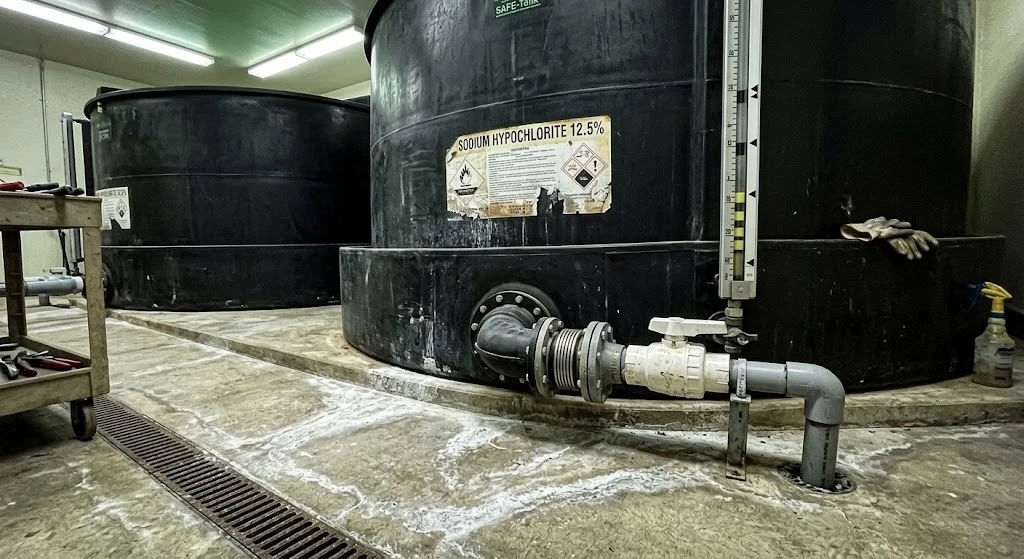
ASTM D1998 — the governing specification for polyethylene chemical storage tanks — formally distinguishes Type I cross-linkable polyethylene tanks from Type II non-cross-linkable polyethylene tanks. That distinction is not cosmetic: it sets different continuous service temperature ceilings for each construction, with Type I tanks rated below 150°F and Type II tanks limited to 140°F. (Source: ASTM International, D1998 standard; Poly Processing)
Manufacturer data backs up why the crosslinked construction earns the higher rating. Assmann specifically identifies improved stress-crack performance from cross-linked resin in services that include sodium hypochlorite and sodium hydroxide — the two chemistries most likely to attack a polyethylene tank wall at fittings, molded transitions, and other highly stressed areas. (Source: Assmann)
None of this makes HDPE categorically wrong — and sodium hypochlorite storage is exactly where that gets tested in public. Snyder Industries builds high-density linear polyethylene (HDLPE) tanks across a broad range of chemical services — including sulfuric acid, hypochlorite, and caustic — and for sodium hypochlorite specifically, Snyder's own technical bulletin recommends HDLPE, not XLPE. Snyder backs that with real accelerated-aging test data run jointly with the University of Nebraska: after six months of exposure to 16.5% sodium hypochlorite at -40°F, HDLPE retained 400 ft-lb of Izod impact strength versus only 160 ft-lb for XLPE. The same bulletin quotes a third-party reference — the Compass Publications Chemical Resistance Guide for Plastics — which lists XLPE for sodium hypochlorite as "Not as good as HDPE." (Source: Snyder Industries, Sodium Hypochlorite Storage technical bulletin)
That is a genuine, named disagreement between manufacturers, not a footnote to wave off. Assmann and Poly Processing build their case around crosslink density resisting the oxidative stress-cracking that sodium hypochlorite promotes at fittings and molded transitions; Snyder builds its case around a homogeneous, rotationally molded wall and a low-temperature impact-resistance test after prolonged chemical exposure. Both are describing real test conditions — they are not measuring the same failure mode the same way, which is part of why the industry hasn't converged on one answer in print. James's own field record — 100+ hypochlorite specifications, all XLPE, zero stress-cracking failures — is why XLPE stays the default recommendation on this page. But "the field record favors XLPE" and "every manufacturer agrees XLPE wins" are two different claims, and a specifier deserves to know Snyder's actual data exists rather than have it summarized away.
For hypochlorite service specifically, Poly Processing's XLPE/OR-1000 construction adds an antioxidant inner layer designed for exactly this failure mode — hypochlorite is a strong oxidizer, and over time it can oxidatively attack the resin and promote stress cracking around outlets and other highly stressed areas. (Source: Poly Processing, OR-1000)
Olin's own handling guidance for sodium hypochlorite identifies both HDPE and cross-linked polyethylene as commonly used storage materials, and it is explicit that resin choice is only one variable — chemical strength, temperature, sunlight exposure, fitting design, mechanical loads, and fabricator experience all affect how long a tank actually lasts in service. Olin also recognizes FRP as a common storage material for larger tanks, with the caveat that resin selection, corrosion-barrier construction, cure system, and fabricator quality become critical to performance there too. (Source: Olin Chlor Alkali; Olin Chlor Alkali)
The Misconception That Wrecks a Spec — and What a Complete One Requires
A specification that simply reads "10,000-gallon polyethylene chemical tank" is not a specification — it's a placeholder. At minimum, a complete tank spec identifies:
In practice, the resin decision is rarely the part that fails first. Vent sizing (hypochlorite off-gasses, so the tank has to breathe properly), outlet design (tank walls move as level changes, so a heavy valve train hung rigidly off a molded nozzle is a liability), and avoiding contaminating metals (transition metals accelerate hypochlorite decomposition) matter almost as much as whether the wall is HDPE or XLPE — which is why a proper spec review looks at the whole tank system, not just the resin callout. Snyder's own hypochlorite bulletin makes that same point from the resin side: it spends as much attention on fitting selection — a titanium SUMO® fitting sized for full drainage, flushed on a six-month schedule to clear the salt buildup and heavy-metal contamination that oxidize polyethylene regardless of resin family — as it does on defending HDLPE over XLPE. Two vendors that disagree on the wall material still agree the fitting and drainage design can make or break the tank.
HDPE vs XLPE FAQ
Why does HDPE fail in sodium hypochlorite service?
Sodium hypochlorite is an oxidizing chemical. Standard HDPE is linear polyethylene with no covalent crosslinks between chains — the oxidizer penetrates the polymer matrix at stress concentration points and initiates micro-cracking that propagates through the wall under hydrostatic load.
Is XLPE just a coated or lined HDPE tank?
No. Crosslinked polyethylene has a fundamentally different molecular architecture — covalent bonds created between polyethylene chains during manufacture, not a coating or liner applied afterward.
How long do HDPE tanks last in trade-grade hypochlorite service?
Field-documented timelines show stress cracking symptoms typically within 12 to 36 months, depending on concentration, temperature, and UV exposure intensity — with the lower end common at higher concentration and temperature in outdoor installations.
Does replacing a failed HDPE tank with another HDPE tank fix the problem?
No — it is a repeated specification error, not a maintenance event. The root cause (linear polymer structure incompatible with sustained oxidizing chemical contact) is unchanged, and the timeline to the next failure begins immediately.
Does ASTM D1998 set different temperature limits for XLPE and HDPE tanks?
Yes. ASTM D1998 rates Type I cross-linkable polyethylene tanks for continuous service below 150°F, while Type II non-cross-linkable polyethylene tanks are limited to 140°F — a direct reflection of the added stress-crack and thermal resistance the crosslinking process provides.
Does specifying XLPE mean I don't have to check chemical compatibility?
No — that's a common misconception. XLPE is not automatically compatible with every chemical. Solvents, hydrocarbons, elevated temperatures, permeating chemicals, oxidizers, and unusual mixtures can all change the compatibility answer, so the resin decision still has to be tied to the actual chemical, concentration, temperature, and fitting design — not assumed from the resin alone.
Does every manufacturer agree XLPE is better than HDPE for sodium hypochlorite?
No, and a specifier should know that. Snyder Industries' own technical bulletin recommends HDLPE over XLPE for sodium hypochlorite, citing accelerated-aging test data run with the University of Nebraska — after six months of exposure to 16.5% NaOCl at -40°F, HDLPE retained 400 ft-lb of Izod impact strength versus 160 ft-lb for XLPE — plus a third-party guide that rates XLPE for sodium hypochlorite as 'Not as good as HDPE.' That is a real, documented disagreement with Poly Processing and Assmann, not a settled industry consensus. It does not reverse the recommendation on this page — James's field record across 100+ hypochlorite specifications is all XLPE with zero stress-cracking failures — but it is exactly the kind of manufacturer-specific data a spec review should surface rather than assume away.
Specifying a sodium hypochlorite storage tank?
Review the complete sodium hypochlorite chemical feed system specification before making any replacement decision.
Ready to buy or need a fast answer? Call, text, or email James directly — (559) 395-5500 · [email protected].