Asahi America Thermoplastic Valves
Asahi/America manufactures thermoplastic valves for corrosive chemical service, water treatment, wastewater, industrial process lines, and high-purity fluid handling. LibertyCES helps select the correct body, elastomer, seat, seal, diaphragm, connection style, and actuation package before the wrong material becomes a maintenance problem.
Specced by James Riggins — 30+ years, 100+ municipal & industrial projects, zero spec failures.
30+ years spec experience. Send James the process data and get a real answer — not a catalog page.
Request a Spec Review →The wrong Asahi valve is rarely wrong because of the brand — it's wrong because the material package doesn't match the service.
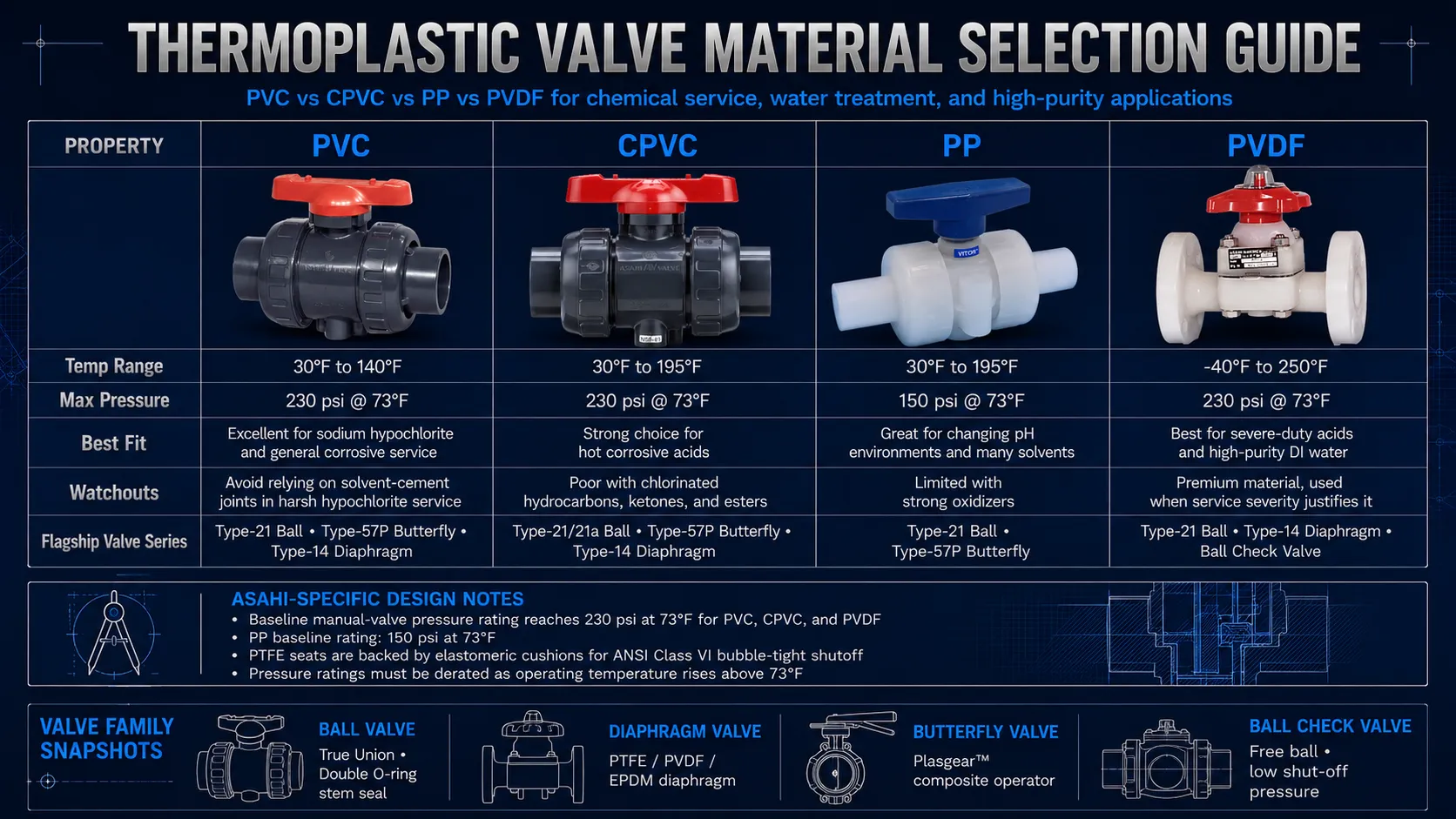
| Material | Best Fit | Watch-Outs |
|---|---|---|
| PVC | Economical choice for many water, mild acid, alkali, brine, and general chemical services | Not for freezing service, many solvents, ketones, esters, aromatics, or chlorinated hydrocarbons |
| CPVC | Higher-temperature corrosive liquids and hot-water service compared with PVC | Limited resistance to amines and many chlorinated or aromatic hydrocarbons |
| PP | Acids, strong alkalis, solvents, variable pH waste streams | Poorer fit for strong oxidizers, chlorinated hydrocarbons, hot concentrated nitric acid, and halogens |
| PVDF | Premium fluoropolymer for high-purity, aggressive chemical, acid, halogen, and hot corrosive service | Not universal; verify caustic and extreme chemical limits |
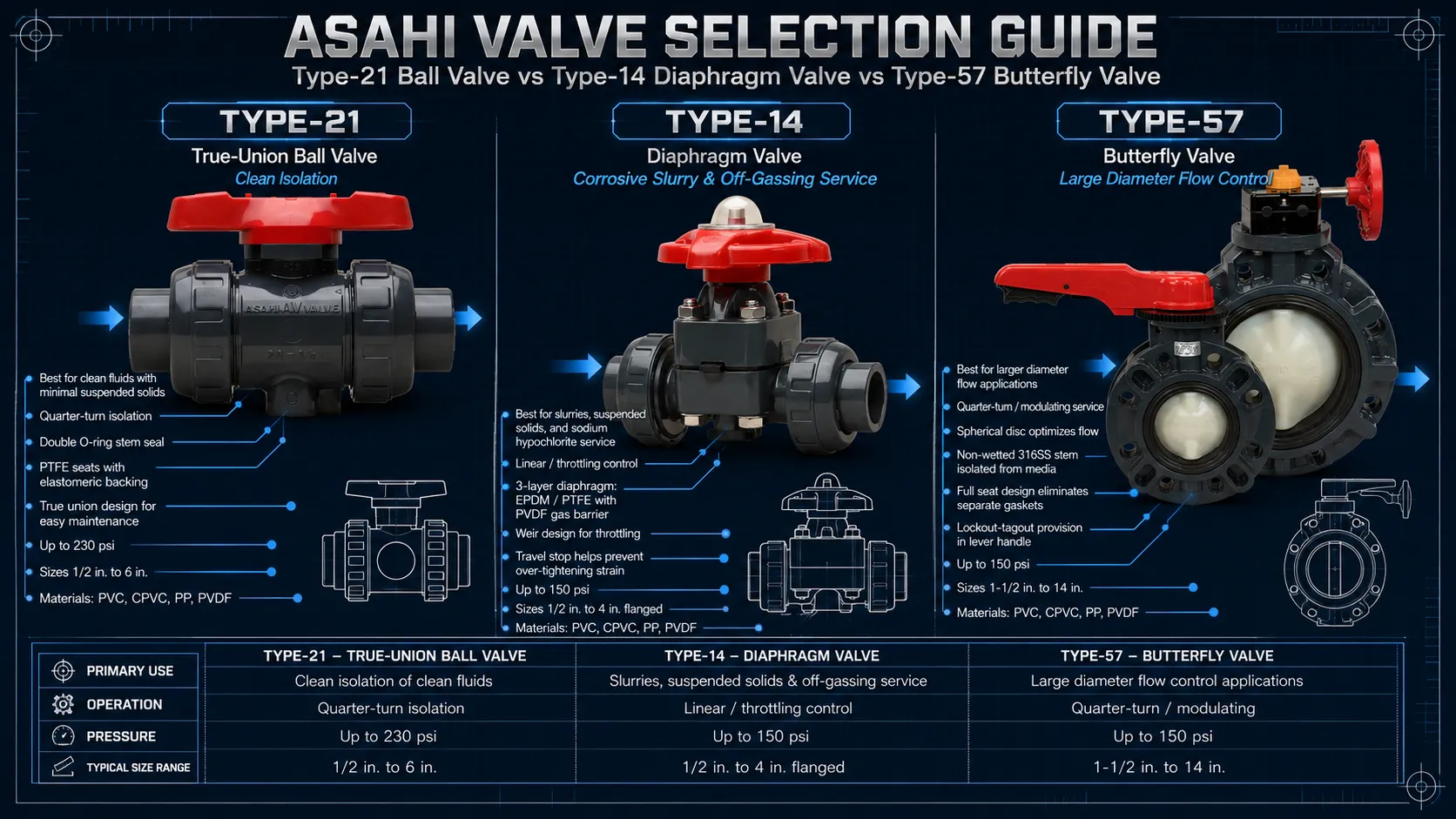
Type-21/21a Ball Valves
Body removable without cutting or rebuilding adjacent pipe
True-union quarter-turn valves for clean on/off service.
- Best for clean on/off isolation
- PVC, CPVC, PP, and PVDF bodies
- PTFE seats with EPDM or FKM backing
- EPDM, FKM, or AFLAS seal options
- Locking handles, limit switches, vented ball configurations available
Type-14 Diaphragm Valves
Handles aggressive off-gassing chemicals + suspended solids
Used when service is more demanding than clean on/off isolation — corrosive chemical service, slurries, suspended solids, and abrasive media.
- Strong for aggressive chemical service
- Good for slurries and suspended particles
- Weir-style diaphragm design
- PTFE or composite diaphragm options for off-gassing service
Type-57P Butterfly Valves
Larger-diameter lines needing moderate flow control, on/off, or modulating service — especially where a compact, corrosion-resistant valve is needed in larger pipe sizes.
- Quarter-turn operation
- Moderate flow control
- Larger-diameter service
- Good suspended-solids tolerance
- Not first choice for heavy slurry or debris
Check Valves
Automatic backflow prevention around chemical feed, transfer, drain, and process piping systems.
- Backflow prevention
- Foot valve and spring-loaded configurations
- Thermoplastic body options
- Seat and seal material selection still matters
Not sure which type and material fit your chemical? Jump to the specification checklist →
Asahi Valve Selection for Sodium Hypochlorite
Sodium hypochlorite service needs more than a generic compatibility check — oxidizer attack, off-gassing, trapped valve-cavity pressure, elastomer degradation, diaphragm gas migration, and weak connection details all matter. Compare the full configuration, not one material name: vented ball valve vs diaphragm valve, PVC vs CPVC body, FKM O-rings and seals, PTFE seats backed with FKM, PTFE/PVDF/EPDM diaphragm construction, and connection strategy.
Full sodium hypochlorite valve material selection guide →
See Asahi Type-21/21a compared against Hayward TBH-Z as an approved-equal substitution →
How to Specify an Asahi Thermoplastic Valve
- Chemical or fluid name, concentration, operating and maximum temperature, operating and maximum pressure
- Pipe size and flow rate
- Valve function: isolation, throttling, control, backflow prevention, drain, sample, chemical feed
- Valve type: ball, diaphragm, butterfly, check, gate
- Body material: PVC, CPVC, PP, PVDF, PFA/PTFE specialty
- Seat, seal/O-ring, and diaphragm materials
- Connection type: socket, threaded, flanged, true-union, butt, fusion
- Manual vs pneumatic vs electric actuation, cycle frequency, indoor/outdoor exposure
- Whether the chemical off-gasses, contains solids/slurry, or has failed before — and where
Asahi America Thermoplastic Valve FAQ
What are Asahi America thermoplastic valves used for?
Asahi/America thermoplastic valves are used for industrial fluid control, chemical processing, water treatment, wastewater, high-purity water, and corrosive chemical applications, across ball, butterfly, check, and diaphragm valve families.
Which Asahi valve is best for on/off chemical isolation?
The Type-21/21a true-union ball valve is a strong starting point. The final material package still depends on body material, seat material, seal material, chemical concentration, temperature, pressure, and connection style.
Which Asahi valve is best for sodium hypochlorite?
It depends on the application — a vented ball valve for isolation, or a Type-14 diaphragm valve with PTFE/PVDF/EPDM diaphragm construction for aggressive off-gassing service.
What is the difference between PVC, CPVC, PP, and PVDF valves?
PVC is economical for many general chemical/water applications. CPVC improves hot-water and corrosive-liquid capability. PP resists many acids, strong alkalis, and solvents but is weaker against strong oxidizers. PVDF is a premium fluoropolymer for more aggressive chemical and high-purity applications.
Are Asahi valves available with pneumatic or electric actuation?
Yes — many Asahi valve applications can be paired with pneumatic or electric actuation depending on valve type, size, operating conditions, cycle frequency, control requirements, and fail-position needs.
Why does elastomer selection matter in Asahi valve specs?
Because the thermoplastic body can be chemically compatible while the seat, seal, O-ring, or diaphragm is not. EPDM, FKM, PTFE, AFLAS, and composite diaphragms must be matched to the chemical, concentration, temperature, pressure, and valve type.
Send the chemical, concentration, temperature, pressure, valve type, and material package
Asahi makes the platform. LibertyCES helps confirm the spec — especially for sodium hypochlorite, caustic, acids, solvents, off-gassing chemicals, or actuated process valves.